Comment démasquer un catfish : Le guide complet de la sécurité sur les sites de rencontre

Ce profil semble parfait. Des photos magnifiques, des centres d'intérêt qui correspondent exactement aux vôtres, et des messages qui vous donnent l'impression d'être la personne la plus spéciale au monde. Mais une petite voix dans votre tête vous chuchote que c'est peut-être trop beau pour être vrai. Cette petite voix a souvent raison. Ce guide vous montrera exactement comment démasquer un catfish, en utilisant des techniques simples et des outils puissants pour vérifier si la personne derrière l'écran est bien celle qu'elle prétend être. Les arnaques sentimentales ont coûté aux victimes 1,3 milliard de dollars rien qu'en 2022, selon la FTC, il est donc crucial de savoir se protéger.
Nous allons aller au-delà des conseils de base et vous donner une méthode concrète pour devenir un véritable détective numérique. Pour une analyse approfondie des techniques de catfishing, consultez notre guide complet sur la détection de catfish et protégez-vous efficacement.
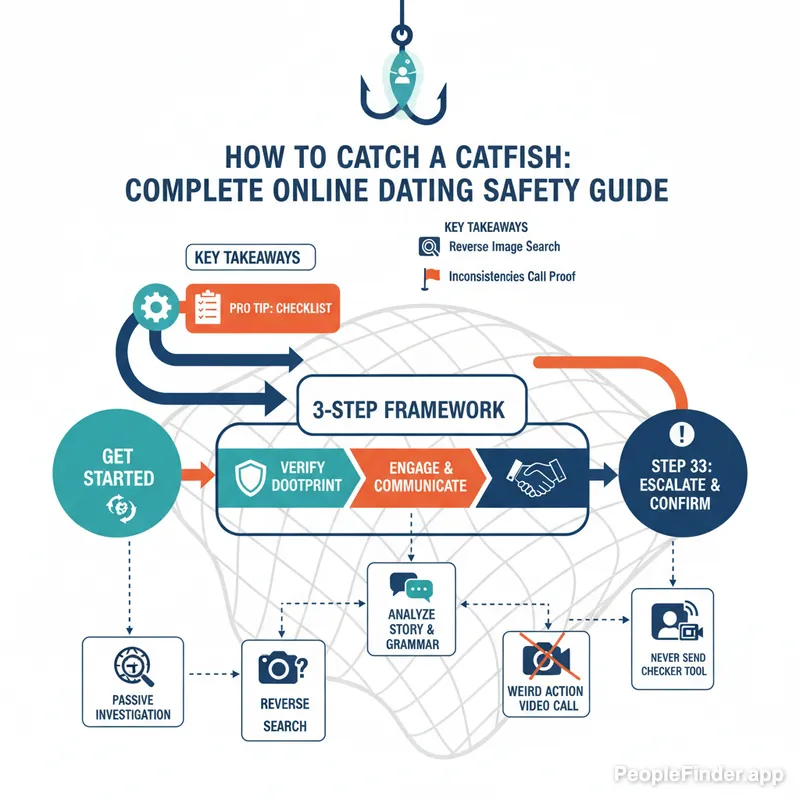
Points Clés à Retenir
- La recherche d'images inversée est votre premier réflexe. C'est le moyen le plus rapide de vérifier si les photos de profil ont été volées ailleurs sur internet.
- Les incohérences sont le plus grand drapeau rouge. Une histoire qui change, des détails flous ou des excuses constantes pour ne pas faire d'appel vidéo sont des signes révélateurs.
- Un appel vidéo est la preuve ultime. Un catfish fera tout pour éviter de montrer son vrai visage en direct. Ne cédez pas aux excuses.
- Faites confiance à votre instinct. Si quelque chose vous semble bizarre, c'est probablement le cas. N'ignorez jamais ce sentiment.
- Utilisez des outils spécialisés. Des plateformes comme PeopleFinder.app peuvent compiler des informations qu'une simple recherche Google ne trouvera jamais, vous offrant une vue d'ensemble.
- Leur empreinte numérique (ou son absence) en dit long. Un manque total de présence en ligne est tout aussi suspect qu'un profil qui semble faux.
Ce dont vous aurez besoin pour commencer
Avant de vous lancer, rassemblez les quelques éléments que vous possédez. Vous n'avez pas besoin de grand-chose pour démarrer votre enquête :
- Les photos de profil : Enregistrez les photos de leur profil de rencontre sur votre appareil.
- Leur nom d'utilisateur et leur prénom : Notez-les précisément, car beaucoup de gens réutilisent les mêmes pseudos sur plusieurs plateformes.
- Toute information personnelle partagée : Ville, lieu de travail, école, adresse e-mail, numéro de téléphone. Chaque détail est un indice potentiel.
- Un esprit critique : C'est votre outil le plus important. Abordez cela avec curiosité, pas avec paranoïa.
La Pyramide de Vérification : Notre méthode pour démasquer un catfish
Pour organiser votre approche, j'ai développé une méthode que j'appelle la "Pyramide de Vérification". C'est un processus en trois étapes, de la plus simple à la plus directe. Vous commencez par la base et ne montez que si des doutes subsistent.
- La Base : Analyse Comportementale. Il s'agit d'identifier les signaux d'alarme classiques et les incohérences dans leur communication. C'est l'étape de l'instinct.
- Le Milieu : Enquête Numérique. Ici, vous utilisez des outils en ligne pour vérifier les faits. C'est l'étape de la collecte de preuves.
- Le Sommet : Confrontation Directe. C'est la dernière étape, où vous demandez une preuve irréfutable, comme un appel vidéo. C'est l'étape de la vérité.
Cette structure vous permet de rassembler des informations progressivement sans paraître immédiatement méfiant.
La base : Faites confiance à votre instinct et repérez les signaux d'alarme
Avant même de lancer une recherche, le comportement d'un catfish le trahit souvent. Voici les signes qui devraient immédiatement attirer votre attention. Beaucoup de ces signes sont également des indicateurs clés pour identifier un arnaqueur de rencontres.
- Le "Love Bombing" : Ils vous déclarent leur amour éternel après seulement quelques jours. C'est une tactique de manipulation conçue pour vous faire baisser votre garde.
- Le profil parfait : Leurs photos semblent tout droit sorties d'un magazine (car c'est souvent le cas). Leurs hobbies sont vagues mais séduisants. Personne n'est parfait.
- L'histoire tragique arrive vite : Ils ont besoin d'argent pour une urgence médicale, un billet d'avion pour vous voir, ou pour régler un problème imprévu. C'est le signal d'alarme ultime.
- Ils évitent les questions précises : Demandez-leur le nom de leur café préféré dans leur quartier ou ce qu'ils ont fait le week-end dernier. Les réponses vagues sont suspectes.
Voici un point de vue qui va à l'encontre de l'idée reçue : tout le monde pense qu'un catfish est un escroc financier. Mais dans mon expérience, beaucoup sont simplement des personnes profondément seules et peu sûres d'elles qui créent un personnage pour échapper à leur réalité. Cela ne rend pas la tromperie acceptable, mais comprendre cette motivation peut vous aider à repérer les incohérences émotionnelles, pas seulement les demandes d'argent.
Le milieu : Menez votre propre enquête numérique
Si votre instinct vous dit que quelque chose cloche, il est temps de passer à la vérification active. C'est là que vous utilisez la technologie pour repérer un catfish. Cette étape est cruciale et peut vous donner une réponse définitive en quelques minutes.
Étape 1 : La recherche d'images inversée, votre meilleur allié
C'est la technique la plus efficace et la plus simple de tout guide de détection de catfish. Elle vous permet de savoir si leurs photos apparaissent ailleurs sur internet, par exemple sur le profil de quelqu'un d'autre ou dans une banque d'images.
- Téléchargez les photos de leur profil sur votre ordinateur ou téléphone.
- Rendez-vous sur un moteur de recherche d'images inversée. Bien que Google Images soit une option, des outils spécialisés donnent de bien meilleurs résultats.
- Utilisez l'outil de recherche d'images inversée de PeopleFinder.app. Notre technologie est conçue spécifiquement pour trouver des profils sociaux liés à une photo, ce qui est beaucoup plus efficace pour comment démasquer un catfish en ligne.
- Analysez les résultats. Si la photo apparaît sur le profil Instagram d'une autre personne avec un nom différent, vous avez votre réponse.
[Note pour le designer : Insérer une capture d'écran montrant l'interface de recherche d'images de PeopleFinder.app avec une photo de profil en cours d'analyse.]
Conseil de pro : Ne vous contentez pas d'une seule photo. Les catfishers utilisent parfois un mélange de photos volées et de photos plus génériques. Vérifiez plusieurs de leurs photos pour avoir une image complète.
Étape 2 : Le "catfish checker" via les réseaux sociaux
La plupart des gens ont une sorte d'empreinte sur les réseaux sociaux. L'absence totale de présence est suspecte pour quiconque a moins de 70 ans.
- Recherchez leur nom et leur nom d'utilisateur sur Facebook, Instagram, LinkedIn, et même TikTok.
- Si vous trouvez un profil, analysez-le : Quand a-t-il été créé ? A-t-il peu d'amis ou d'abonnés ? Les photos ont-elles des likes ou des commentaires de vraies personnes ?
- Le test ultime : les photos identifiées. C'est un détail que les catfishers oublient souvent. Regardez les photos où ils sont identifiés par d'autres. Si un profil n'a aucune photo identifiée, c'est un énorme drapeau rouge. Personne n'existe dans le vide.
Étape 3 : Une recherche Google approfondie
Ne sous-estimez pas la puissance d'une simple recherche. Mettez leur nom entre guillemets ("Prénom Nom") pour une recherche exacte. Ajoutez des détails comme leur ville ou leur profession ("Prénom Nom" + "Ville"). Si vous avez leur e-mail ou leur numéro de téléphone, recherchez-les également. Un outil comme PeopleFinder peut faire ce travail pour vous, en croisant les informations dans les registres publics et les bases de données en ligne pour vous donner un rapport complet.
Le sommet : La vérification ultime et la confrontation
Si vos recherches ne sont pas concluantes mais que vos doutes persistent, il est temps de passer à la dernière étape. C'est la plus directe, mais aussi la plus efficace.
Proposez un appel vidéo sans pression
C'est la solution miracle. Un vrai "catfish checker". Proposez un appel vidéo de manière décontractée. "J'adorerais enfin mettre une voix (et un visage !) sur tes messages. Tu es libre pour un rapide appel vidéo ce soir ?"
Les excuses vont commencer à pleuvoir :
- "Ma caméra est cassée."
- "Je suis timide / Je n'aime pas les appels vidéo."
- "La connexion est mauvaise là où je suis."
- "Je suis avec ma famille et je ne peux pas parler."
Une excuse est possible. Une série d'excuses est la confirmation que vous parlez à un catfish. Une personne réellement intéressée trouvera un moyen de vous parler en vidéo, même pour cinq minutes.
Conseil de pro : Pour les déjouer, suggérez une alternative simple. "Pas de problème pour la caméra, faisons juste un appel vocal alors !" ou "Et si tu m'envoyais un selfie rapide en faisant un signe de paix ? Juste pour que je sache que tu es réel." Leur refus de faire même ce simple geste en dira long.
Posez des questions spécifiques basées sur vos recherches
Si vous avez trouvé des informations contradictoires, posez des questions à ce sujet. "Oh, j'ai vu sur un profil que tu avais travaillé chez X, comment c'était ?" S'ils n'ont jamais travaillé là, leur réaction vous donnera votre réponse.
Voici mon deuxième point de vue non conventionnel : les gens se concentrent trop sur la recherche d'images. J'ai découvert que le langage et la chronologie sont des indicateurs encore plus puissants. Un catfish qui prétend être un chirurgien à New York mais qui écrit avec des fautes de grammaire et n'est en ligne qu'à 3 heures du matin, heure de l'Est, est beaucoup plus facile à démasquer qu'une personne qui a simplement utilisé des photos d'un profil privé. Faites attention à comment et quand ils communiquent.
Tableau comparatif des méthodes de vérification
Pour vous aider à choisir le bon outil pour votre situation, voici une comparaison rapide des principales méthodes pour démasquer un catfish.
| Méthode | Facilité d'utilisation | Précision | Portée des résultats | Idéal pour... |
|---|---|---|---|---|
| Recherche Google Images | Très facile | Moyenne | Sites web publics, articles | Vérifier si une photo est une image de stock ou celle d'une célébrité. |
| Recherche sur les réseaux sociaux | Facile | Variable | Profils sur une plateforme spécifique | Confirmer l'existence sociale et analyser le cercle d'amis. |
| PeopleFinder.app | Très facile | Élevée | Profils sociaux, registres publics, empreintes numériques cachées | Une enquête approfondie et rapide qui relie une photo à de multiples profils et données. |
| Appel vidéo | Facile | Maximale | Confirmation en temps réel | La preuve irréfutable pour mettre fin à tous les doutes. |
Que faire quand les pistes sont brouillées ?
Parfois, l'enquête n'est pas si simple. Voici comment gérer les situations délicates.
"Leur recherche d'images ne donne rien."
Cela peut signifier plusieurs choses. Ils utilisent peut-être des photos d'un profil Instagram très privé que les moteurs de recherche ne peuvent pas indexer. Ou, plus inquiétant, ils pourraient utiliser des photos générées par l'IA. Dans ce cas, concentrez-vous encore plus sur les incohérences comportementales et insistez pour un appel vidéo.
"Ils ont une excuse pour chaque signal d'alarme."
C'est une tactique de manipulation en soi. Un maître manipulateur aura toujours une explication plausible. La question n'est pas de savoir si chaque excuse est crédible individuellement, mais de constater le schéma d'excuses. Personne n'a une vie aussi compliquée et malchanceuse en permanence. Faites confiance à la tendance générale, pas à l'excuse du jour.
"Et si c'est une vraie personne, mais qu'elle a menti sur quelques détails ?"
C'est ce qu'on appelle le "kittenfishing". Ils utilisent leurs vraies photos mais mentent sur leur âge, leur taille ou leur travail. C'est toujours une tromperie. Si vous les surprenez à mentir sur de petites choses, demandez-vous sur quoi d'autre ils pourraient mentir. La confiance est le fondement de toute relation.
Les rencontres en ligne peuvent être frustrantes, mais elles restent un excellent moyen de rencontrer des gens. Une étude de 2023 du Pew Research Center a révélé que 3 couples sur 10 se sont rencontrés en ligne. En utilisant les techniques de ce guide, vous pouvez naviguer dans cet univers en toute sécurité et confiance. Pour d'autres outils de recherche, vous pouvez consulter cette liste des 10 meilleurs moteurs de recherche d'images inversée.
Si vous avez suivi toutes ces étapes et que vous voulez une vérification finale et complète, il est temps d'utiliser un service professionnel. Essayez PeopleFinder.app dès aujourd'hui pour lancer une recherche approfondie et obtenir la tranquillité d'esprit que vous méritez.
Questions Fréquemment Posées
Quelle est la différence entre un catfish et un arnaqueur ?
Un catfish trompe pour des raisons émotionnelles, comme la solitude ou l'insécurité, tandis qu'un arnaqueur (scammer) a un objectif purement financier. Cependant, les tactiques se chevauchent souvent, et un catfish peut facilement devenir un arnaqueur en demandant de l'argent une fois la confiance établie.
Est-ce que je risque des problèmes légaux en enquêtant sur quelqu'un en ligne ?
Non, tant que vous utilisez des informations accessibles au public. Utiliser des moteurs de recherche, des réseaux sociaux et des outils comme PeopleFinder.app pour rechercher des informations publiques est tout à fait légal. Vous ne devez pas essayer de pirater des comptes ou d'accéder à des informations privées.
Que dois-je faire une fois que j'ai confirmé que c'est un catfish ?
Bloquez-les immédiatement sur toutes les plateformes. Ne les confrontez pas de manière agressive, car cela peut entraîner du harcèlement. Signalez leur profil sur l'application de rencontre pour protéger les autres. Si vous leur avez envoyé de l'argent, contactez votre banque et signalez l'incident aux autorités.
Pourquoi les gens font-ils du catfishing ?
Les motivations sont variées. Certains le font par solitude, faible estime de soi, ou pour explorer leur identité. D'autres sont malveillants et le font pour l'arnaque financière, le harcèlement, ou simplement pour le plaisir de tromper les autres. Comprendre la motivation n'excuse pas le comportement.
Les applications de rencontre ne sont-elles pas censées empêcher cela ?
Les applications de rencontre essaient, en mettant en place des systèmes de vérification de profil (comme le badge bleu). Cependant, les catfishers trouvent toujours des moyens de contourner ces mesures. La vérification de profil est un bon début, mais elle ne remplace pas votre propre vigilance.
Comment PeopleFinder.app peut-il m'aider concrètement à démasquer un catfish ?
PeopleFinder.app excelle dans la connexion des points. Vous pouvez utiliser une seule information, comme une photo, un nom d'utilisateur ou une adresse e-mail, et notre outil recherchera dans des centaines de sources en ligne pour trouver des profils sociaux, des photos supplémentaires et d'autres empreintes numériques associées, vous donnant une image complète bien plus rapidement qu'une recherche manuelle.
Est-il possible qu'une personne réelle n'ait aucune présence sur les réseaux sociaux ?
Oui, c'est possible, mais c'est de plus en plus rare, surtout pour les personnes de moins de 50 ans. Une absence totale de résultats sur Google et les réseaux sociaux, combinée à d'autres signaux d'alarme (comme le refus d'un appel vidéo), est extrêmement suspecte. C'est un schéma qui doit être pris au sérieux.
Find Anyone Online in Seconds
Upload a photo and our AI finds matching profiles across the entire internet.
Start Free Search →
Written by
Ryan Mitchell
Ryan Mitchell est chercheur en confidentialité numérique et spécialiste OSINT avec plus de 8 ans d'expérience dans la vérification d'identité en ligne, la recherche d'images inversée et les technologies de recherche de personnes. Il se consacre à aider les gens à rester en sécurité en ligne et à démasquer la tromperie numérique.
Articles Récents
- Violation de la propriété intellectuelle : Un guide pratique pour 2026
25 août 2026
- Retrouver des amis perdus : Outils PeopleFinder et étapes détaillées
23 août 2026
- Lier les comptes de médias sociaux : un guide complet
22 août 2026
- Devrais-je m'inquiéter d'une vérification des antécédents ?
21 août 2026
- Recherche d'images d'arnaqueurs : Comment repérer rapidement les fausses photos
20 août 2026
You Might Also Like
- 9 Best Free Reverse Image Search Tools (2026 Updated)
24 févr. 2026
- Outils de Recherche d'Images Inversée Gratuits Qui Fonctionnent Vraiment
24 févr. 2026
- Trouver une personne par photo : 8 méthodes gratuites qui fonctionnent réellement
24 févr. 2026
- How to Reverse Image Search on iPhone in 2026 (4 Methods)
23 févr. 2026
- PimEyes vs FaceCheck : Quelle recherche faciale l'emporte en 2026 ?
24 févr. 2026
Articles Populaires
- Comment trouver quelqu'un sur les réseaux sociaux avec une photo : Le guide complet
- Trouver une personne par photo : 8 méthodes gratuites qui fonctionnent réellement
- Face Recognition Search: How AI Identifies People by Photo
- 9 Best Free Reverse Image Search Tools (2026 Updated)
- 10 Meilleurs Moteurs de Recherche d'Images Inversée en 2026
Articles Connexes
9 Best Free Reverse Image Search Tools (2026 Updated)
24 févr. 2026
Outils de Recherche d'Images Inversée Gratuits Qui Fonctionnent Vraiment
24 févr. 2026
Trouver une personne par photo : 8 méthodes gratuites qui fonctionnent réellement
24 févr. 2026
How to Reverse Image Search on iPhone in 2026 (4 Methods)
23 févr. 2026
PimEyes vs FaceCheck : Quelle recherche faciale l'emporte en 2026 ?
24 févr. 2026
Face Finder: 6 Best Tools to Identify Unknown Faces
2 mars 2026
Face Recognition Search: How AI Identifies People by Photo
27 févr. 2026
Qu'est-ce que la recherche d'images inversée ? Explication simple + Outils
9 mars 2026
10 Meilleurs Moteurs de Recherche d'Images Inversée en 2026
23 févr. 2026
7 façons de faire une recherche d'image inversée sur iPhone comme un pro
20 févr. 2026
How to Reverse Image Search on iPhone in 2026 (4 Methods)
23 févr. 2026
How Reverse Image Search Works: A Complete Beginner's Guide
22 févr. 2026
Photos volées en ligne ? Retrouvez-les avec la recherche inversée d'images
20 févr. 2026
Recherche d'Image Inversée : Le Guide Ultime Pour Tout Trouver en Ligne 2026
22 févr. 2026